Swelling is not just puffiness
A swollen joint is a sabotaged joint. Fluid pressure inside and around a knee or ankle does more than stretch the skin — it reflexively inhibits the muscles that cross the joint. This is why a swollen knee's quadriceps won't fire properly no matter how hard you try, and why swelling control is a performance issue, not a comfort issue. Every day a limb stays swollen is a day the strengthening part of rehab underperforms.
Your body clears swelling through the venous and lymphatic systems, both of which rely on movement and muscle contraction as their pumps. Early after surgery or injury — precisely when swelling peaks — you're moving least. That's the gap pneumatic compression fills: it becomes the pump you can't yet be.
A squeeze with a direction
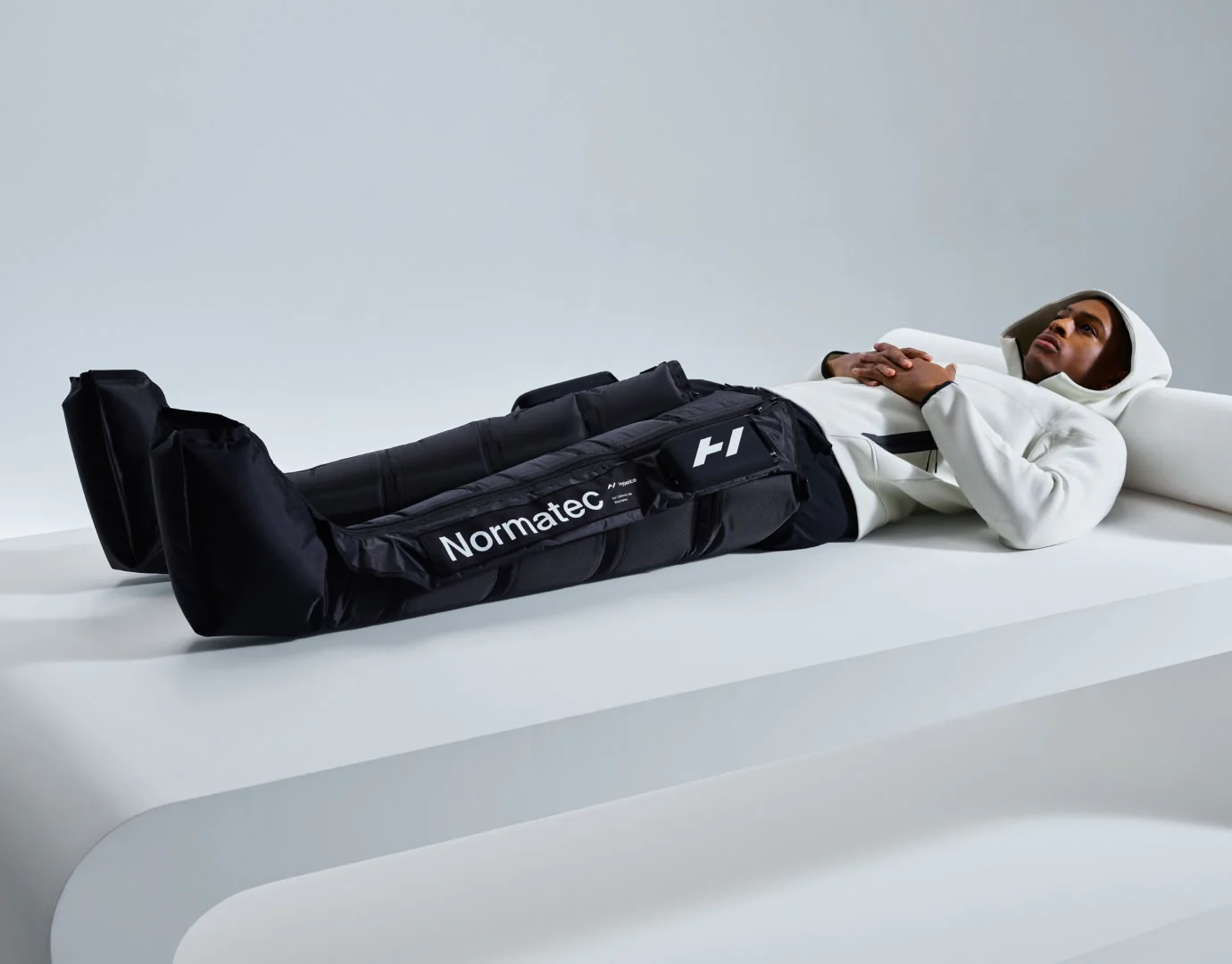
The sleeve wraps the limb in a series of chambers. They inflate in sequence — foot first, then calf, then thigh — creating a wave of pressure that travels toward the heart, exactly the direction pooled fluid needs to go. Then everything deflates, fresh blood flows in, and the cycle repeats. Fifteen to twenty minutes of that, and a limb that felt tight and heavy usually looks and feels visibly different.
What the studies support
The research on pneumatic compression clusters around recovery: reduced perceived soreness and muscle heaviness, modest improvements in markers of exercise-induced muscle damage, and effective swelling management. It's a legitimate recovery and swelling tool — not a treatment that changes tissue structure. We're comfortable with that distinction, and we program it accordingly.
Across trials of lower-limb pneumatic compression, recovery outcomes — especially perceived soreness — improved versus passive rest.
View study →Intermittent pneumatic compression reduced markers of exercise-induced muscle damage in endurance athletes.
View study →